1.Crust: The Earth's crust consists largely of igneous rock along with smaller amounts of metamorphic and sedimentary rock. The crust and the attached solid upper mantle are in turn
broken up into a series of individual pieces known as tectonic plates.
2. Mantle: The mantle is made of incredibly hot rock, kept solid by immense lithospheric pressures.
3. Core: Outer core - predominately liquid iron and nickel.
Inner core - predominately solid iron and nickel.
Inner core - predominately solid iron and nickel.

What are the types if rocks on the earth?
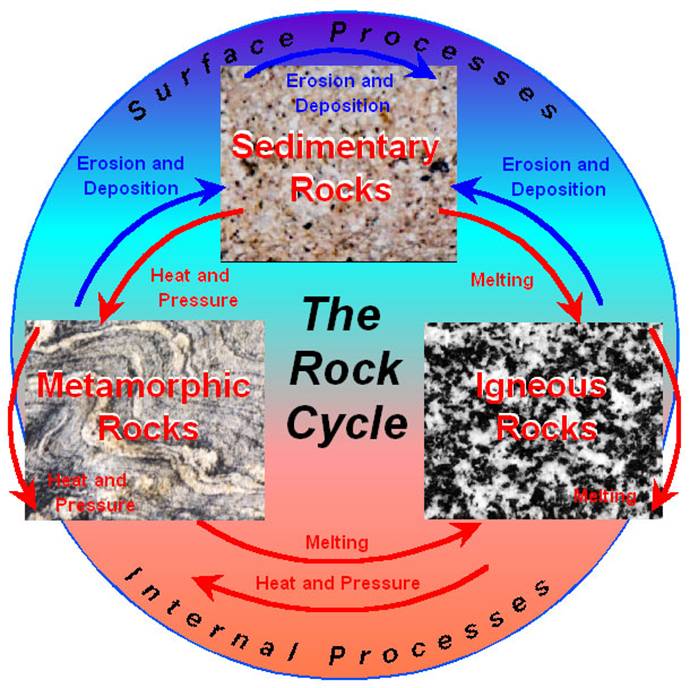
1.Igneous Rocks: Igneous rocks are formed deep inside Earth's crust (intrusive rocks) or at the surface (extrusive rocks). As molten rock (known as magma) below the surface cools, the liquid material begins to solidify into minerals of differing sizes and compositions. Generally, the longer the cooling time, the larger the mineral crystals can grow. Trapped deep in the Earth, magma is allowed to cool slowly. Examples of intrusive rocks are granite and gabbro. Granite is made up of three common minerals - quartz, mica and feldspar - and when viewed from a distance appear tan, pinkish or gray, depending on the concentrations and grain sizes of the three minerals. This rock is very widely used as a building material, due to its abundance and strength. Gabbro has a lower quartz content than granite, and is therefore much darker. Liquid rock that reaches the surface cools very quickly. As a result of this immediate cooling, the crystals produced are extremely small. These tiny-grained minerals tend to give these extrusive rocks a rather opaque, homogenous color. All of the world's sea floors are produced in this manner of rapid cooling, and the dark-gray, heavy rock produced is called basalt. Andesite (named after the Andes Mountains in South America) is a cousin to basalt in that it is also volcanic in nature, but is lighter-colored due to the decreased concentration of darker minerals.
2. Sedimentary Rocks: Have you ever been to the beach and nestled your toes in the sand? Over thousands of years that sand might become part of a sedimentary rock!
Sedimentary rocks make up about three-quarters of the rocks at the Earth’s surface. They form at the surface in environments such as beaches, rivers, the ocean, and anywhere that sand, mud, and other types of sediment collect. Sedimentary rocks preserve a record of the environments that existed when they formed. By looking at sedimentary rocks of different ages, scientists can figure out how climate and environments have changed throughEarth’s history. Fossils of ancient living things are preserved in sedimentary rocks too.
Many sedimentary rocks are made from the broken bits of other rocks. These are calledclastic sedimentary rocks. The broken bits of rocks are called sediment. Sediment is the sand you find at the beach, the mud in a lake bottom, the pebbles in a river, and even the dust on furniture. The sediment may, in time, form a rock if the little pieces become cemented together.
There are other types of sedimentary rocks whose particles do not come from broken rock fragments. Chemical sedimentary rocks are made of mineral crystals such as halite andgypsum formed by chemical processes. The sediment particles of organic sedimentary rocksare the remains of living things such asclamshells, plankton skeletons, dinosaur bones, and plants.
3. Metamorphic Rocks: Metamorphic rocks are rocks that have "morphed" into another kind of rock. These rocks were once igneous or sedimentary rocks. How do sedimentary and igneous rocks change? The rocks are under tons and tons of pressure, which fosters heat build up, and this causes them to change. If you exam metamorphic rock samples closely, you'll discover how flattened some of the grains in the rock are.

Tidak ada komentar:
Posting Komentar